The news is out that the SAT is changing for 2016. Here are a few thoughts on what the announced changes will likely mean for those prepping for the new version of this popular college admissions exam.
The big, sweeping change to education over the past decade can be summarized by the term "content." E.D. Hirsch's Core Knowledge was the first major initiative to draw attention to evidence that college students were failing not because they couldn't read, but because they were clueless regarding the topics about which they were reading. That is, students must have background knowledge--content--in order to understand readings. This concept was spread throughout the United States with the introduction of the Common Core State Standards.
To borrow a phrase from internet speak, the new SAT seems to be following the adage that "content is king."
1. Evidence must be used to support answers.
It's highly doubtful that multiple-choice questions will disappear; these are just too cost-effective in terms of grading, to give up entirely. It is likely that certain questions will require explanations; for example, noting which paragraph within a passage the student used in answering a question.
2. Vocabulary will be more content-specific.
We can all still expect to see terms such as loquacious on the SAT. But because "content is king," we can also expect to see terms directly related to college-level coursework, e.g. variable, analysis, structure, research, hypothesis, paradigm, algorithm.
3. Fewer mathematics topics will be covered, in favor of more in-depth knowledge of each topic.
A good guess is that superficial knowledge of a topic like geometry will no longer be enough; that it will be better to have mastered geometry as much as possible, than to remember a smidgen from each of several mathematics courses.
4. Parts of the math section(s) will not allow calculators.
This may mean students re-learning basic mathematics skills that may have been forgotten, such as multiplication and long division.
5. Primary-source documents will be used.
Again, "content is king." The use of primary-source documents on the new SAT mimics the use of them on AP exams. College students are expected to cite their sources, and it is only natural that the SAT should test their ability to analyze documents and cite them.
6. No more penalties for wrong answers.
This alone should raise scores.
7. The essay is optional.
This is a tricky item to approach. Skipping the essay will depend upon the sort of college to which a student hopes to be accepted. Selective institutions will likely want to see written exam scores, whereas less selective colleges may not care so much. There's no word on how or whether skipping the written portion will affect the total SAT score. For now, the advise is to skip the written essay only if the student's writing skills are poor.
8. Scores go from a possible total of 2400 to 1600.
This seems to be a return to the simpler scoring of a couple of decades ago.
9. The test will be available online.
This does not mean that you'll be able to take the new SAT at home. Instead, like tests such as the GRE, testing centers will allow students the option of completing the test on a computer. Before selecting this option, a student should test himself or herself, to see which format works best. Anecdotally, it's been observed that a lot of students "bomb" computer tests because they click through them too quickly.
The good news for students is that removing penalties for incorrect answers will result in overall higher SAT scores. The jury is still out on whether skipping the written essay will be good or bad.
In general, like K-12 education, the general trend is toward content-specific knowledge. This means more non-fiction reading passages, which research shows require background knowledge to comprehend.
How to prep for the new SAT? In addition to reading the high school literature canon, students will want to read more nonfiction. This nonfiction should include books on science and history.
Showing posts with label Test Prep. Show all posts
Showing posts with label Test Prep. Show all posts
Sunday, April 26, 2015

Tuesday, September 20, 2011
Is it September already?
Yes, it's September already. In fact, as of today, September is two-thirds finished. How is your school year shaping up? We have been busy little bees!
Prep, prep, prep...for many of us, it's a necessity. If you cover a "homeroom" class in the morning, or simply want to get your kids "in the zone" at the start of the day, try a daily online quiz. We have a quiz for every single day of the year. These quizzes run the gamut, with the primary focus on social studies.
Prep, prep, prep...for many of us, it's a necessity. If you cover a "homeroom" class in the morning, or simply want to get your kids "in the zone" at the start of the day, try a daily online quiz. We have a quiz for every single day of the year. These quizzes run the gamut, with the primary focus on social studies.
Thursday, May 26, 2011
Free Printable Tally Score Sheet for Euchre and More

This free printable tally score sheet can be used for tournament games of progressive euchre, bridge, and canasta. It can also be used for fun classroom test-prep review games.
How to play as a class:
First, you will need question cards. Try printing some of our cards, or make your own. You might even have the kids each make ten or so question cards from a study sheet.
Have prizes ready and clearly marked. You can do first-, second-, and third-place prizes (with something small for "everyone else"). You can also do prize ranges based on point totals (kind of like the tiered prizes offered at festival games).
- This particular tally sheet works for student players totaling multiples of 12 (12, 24, 36, etc.). With 12 students, you will need 3 tables, followed by 6 tables for 24 students, 9 tables for 36 students, etc. (four student players per table).
- If you have 6 or 9 tables going, randomly divide the class into color-coded teams. Print each team's tally card on colored copy paper.
- You will also need a score writer/question reader for each table. This job can be done by "extra" students, teachers, parents, etc. (Note: If the students are playing for prizes, be sure to offer good prizes to students who volunteer for this job.)
- Questions can be answered and scored different ways. (1) The "reader" can read the question, then have students slap the table, raise a hand, or ring a buzzer. The first correct answer gets the point for the question. (2) All students can have 15-20 seconds to write the answer to the question. The "reader" checks the answers and gives a point to each student with a correct answer.
- Each tournament lasts eleven rounds. If you instruct the students to do ten questions per round, each round should be done in about five minutes or less. This totals 55 minutes.
- To keep kids moving quickly, try ringing a bell. After 4:30, ring the bell and say, "Thirty seconds left." After 5:00, ring the bell and say, "Move onto round ___." The 5 minutes-per-round time limit will keep students focused because the kids will want a chance to earn all possible points for that round.
In this tournament, students have no choice regarding their partners. Each student on a 12-person team will have a chance to play with every other person on her/his team. This means, particularly if students play as partners at each table, no "two troublemakers" will be partners at the same table more than once. There is simply no time in this game for kids to drift off or become behaviorally inappropriate.
Saturday, July 17, 2010
Interactive Geography Games
Our interactive geography games cover every country on every continent. Test your knowledge of state and national capitals, regional features, and more. These can be used by any person of any age. We have seen these played by fifth-graders (are you smarter than one?), college students, and mature adults. They're not just educational...they're free and fun.
Enjoy!
Enjoy!
Sunday, July 4, 2010
Happy Fourth of July!
Why not honor American independence by testing your American history knowledge?
American History Module 3.1: A New Colonial System
American History Module 3.2: The Stamp Act
American History Module 3.3: Taxation without Representation
American History Module 3.4: The Townshend Acts
American History Module 3.5: Samuel Adams
American History Module 3.6: The Boston Tea Party
American History Module 3.7: The Coercive Acts
American History Module 3.8: The Revolution Begins
American History Module 3.9: Common Sense and Independence
American History Module 3.1: A New Colonial System
American History Module 3.2: The Stamp Act
American History Module 3.3: Taxation without Representation
American History Module 3.4: The Townshend Acts
American History Module 3.5: Samuel Adams
American History Module 3.6: The Boston Tea Party
American History Module 3.7: The Coercive Acts
American History Module 3.8: The Revolution Begins
American History Module 3.9: Common Sense and Independence
American History Module 3.10: Defeats and Victories
Friday, June 25, 2010
Classroom Proficiency Test Prep
Are you looking for fun ways to prepare for tests in the classroom? If you have a SmartBoard or projector attached to your computer or laptop, preparing as a class just got easier. We have numerous chapter-specific and topic-specific online quizzes in a variety of formats that you can use with students in many different ways.
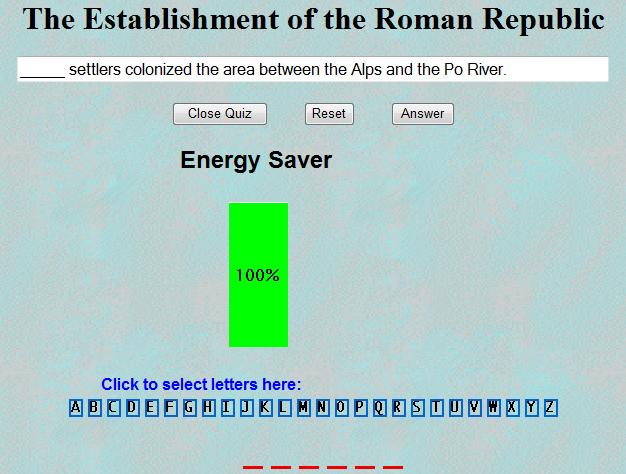
Our ENERGY SAVER quizzes operate just like old-fashioned Hangman. At the top, there is a question or a sentence with a blank space. Below is the energy box. Below this is the alphabet. At the bottom, there is one space for each letter of the answer or missing term. Students guess letters that they believe are part of the answer. When they guess incorrectly, the energy supply is depleted. These are great on a SmartBoard for playing as a class, or individually in the computer lab. If you have a classroom blog or webpage, you can link students directly to quizzes and games that they can do at home.

SILVERLIGHT MULTIPLE-CHOICE is a multiple-choice testing format which presents each question individually, rather than all questions on a single screen. Many of these questions incorporate visual elements, common on state regents and proficiency exams.
 PLAYTIME is a two-player or two-team multiple-choice game that has a Vegas vibe to it. Each player pulls the lever to receive a question. The player with the biggest winnings is the winner.
 MULTIPLE-CHOICE quizzes are created in a single-page format. These can be done as a group. They are excellent tools for individual students to use when studying for a test or exam.

FLASH CARDS have gone digital! Read the card, then answer it aloud or in your head. Flip it over to see if you were right. Track how many correct or incorrect answers you get. As you flip through the cards, remove those which you already know so that they aren't repeated.
None of these game styles are ultra-new or mind-blowing. But combining them with your SmartBoard or projector can make for a fun and productive classroom study session. They are all interactive, which means that no pencils, paper, chalk, boards, etc., are necessary.
Perhaps more importantly, our games are unit, chapter, and section specific. For example, under Roman civilization, we have five topics:
- The Establishment of the Roman Republic
- The Punic Wars
- Civil War in Rome and the End of the Roman Republic
- The Rise and Fall of the Roman Empire
- The Barbarian Invasions and Migratory Period in Europe
Even better, all of our games are offered online for free. This means no CD-Roms to store, no membership fees, and no hassle. You don't even need a password or log-in to use the site and test your skill. Use these educational games and quizzes in the classroom or at home, for regular chapter tests, exam preparation, or even quiz bowl practice.
You can start by browsing our WORLD HISTORY games. If you don't see precisely what you're looking for, fret not. We are hard at work creating and uploading new games every day.
Monday, June 14, 2010
Free Educational Online Games
Our new games are up and running. These are free educational games that you can play online. They run the gamut of high school courses (and then some). We intend to add new games pretty much every day, so check back often. These games are a great way to:
- Keep your mind sharp and focused over the summer (so that you don't 'forget' everything).
- Prepare in advance for tough AP (Advanced Placement) and other advanced/honors courses.
- Hone your skills for college admissions tests (such as the ACT and SAT).
- Save yourself from mindless boredom, watching hours of reruns on TV.
- Have fun!
As you know, our games are 100% free. You don't have to log in or any of that rigamarole. Just click on a game and start playing.
Capitals of Central American Countries
Capitals of Eastern Asia
Capitals of Western Asia
Caribbean Country Capitals
Classical Civilizations
College Admissions Test Prep Vocabulary Quiz 9.1
Main Game Page (Note: We wanted to get these games out to you asap, so some of the HTML may look a little wocky. The game pages are all fine, but the pages listing the games still need a bit of work. You'll see what we mean. Don't worry...we're working hard to clean up the listings pages.)
Thursday, June 3, 2010
Final Exams Word Search Puzzle
E X R Q U X K Q O E S O B P S T N P R O C T O R P
K S L E S R R N V X P P M J S S R X T D X P W O Q
O T S N C J B I O E E M E A Y X E O F F E E H Q M
O R S A S A T K N W J V F C E L C U L I A F R P U
B U K N Y C L B Y M R K C N F O G A G N Y M Z Q L
D V X U E Q O L S H A R P E N E D P E N C I L S T
E A R J M O U S I E G F J C W M A T S M V D A K I
S T B E K X L E R N E U E H A S T B M A N V C Q P
O O E G A W P B S R G N A O S I E M B F X I A P L
L S I E U D Y N O T T G N I R E B M E M E R D O E
C C R F H H I C O R I A W W E K S Q X U T D E S C
M T H A T S S N A I P O N S T B E G I N M T M S H
Q T N L S W E T G S T Y N E Y A T F Z Q O F I Q O
W J A O K F E L W U R S V S U N O W G B P L C Y I
X E K D S F E E B U Q C E R C S N O J H E W F J C
H E I V C S O C M B Z T Z U B W C R B D N C G G E
C V Y S L U L A W I U M H O Q E E A D C O M E L N
Q Q H J I U L R E B R B R C D R R L X I J Q G W M
F W E G E Y L I T M C P E R N O T A L K I N G F K
O K S S H J G N I M M A R C A C U Y G Q E D A R G
Terms:
ACADEMIC
ANSWER
BEGIN
BUBBLE SHEET
CLOSED BOOK
CLUES
CONCENTRATE
COURSES
CRAMMING
ESSAY QUESTIONS
FAIL
GRADE
GUESS
HEALTHY BREAKFAST
KNOW
MULTIPLE-CHOICE
NO TALKING
NOTES
OBJECTIVE
OPEN BOOK
ORAL
PASS
PROCTOR
QUESTION
READING
RECALLING
REMEMBERING
SCORE
SHARPENED PENCILS
WRITTEN
Click here for a printable version of this puzzle and the answer key.
K S L E S R R N V X P P M J S S R X T D X P W O Q
O T S N C J B I O E E M E A Y X E O F F E E H Q M
O R S A S A T K N W J V F C E L C U L I A F R P U
B U K N Y C L B Y M R K C N F O G A G N Y M Z Q L
D V X U E Q O L S H A R P E N E D P E N C I L S T
E A R J M O U S I E G F J C W M A T S M V D A K I
S T B E K X L E R N E U E H A S T B M A N V C Q P
O O E G A W P B S R G N A O S I E M B F X I A P L
L S I E U D Y N O T T G N I R E B M E M E R D O E
C C R F H H I C O R I A W W E K S Q X U T D E S C
M T H A T S S N A I P O N S T B E G I N M T M S H
Q T N L S W E T G S T Y N E Y A T F Z Q O F I Q O
W J A O K F E L W U R S V S U N O W G B P L C Y I
X E K D S F E E B U Q C E R C S N O J H E W F J C
H E I V C S O C M B Z T Z U B W C R B D N C G G E
C V Y S L U L A W I U M H O Q E E A D C O M E L N
Q Q H J I U L R E B R B R C D R R L X I J Q G W M
F W E G E Y L I T M C P E R N O T A L K I N G F K
O K S S H J G N I M M A R C A C U Y G Q E D A R G
Terms:
ACADEMIC
ANSWER
BEGIN
BUBBLE SHEET
CLOSED BOOK
CLUES
CONCENTRATE
COURSES
CRAMMING
ESSAY QUESTIONS
FAIL
GRADE
GUESS
HEALTHY BREAKFAST
KNOW
MULTIPLE-CHOICE
NO TALKING
NOTES
OBJECTIVE
OPEN BOOK
ORAL
PASS
PROCTOR
QUESTION
READING
RECALLING
REMEMBERING
SCORE
SHARPENED PENCILS
WRITTEN
Click here for a printable version of this puzzle and the answer key.
Friday, May 28, 2010
Free Online United States Geography Quiz
How well do you know the capital cities of the Western stats? We have created a simple online quiz to test your knowledge. All that you need to do is (using multiple-choice) name the capitals of the 13 Western states within 13 minutes. Good luck!
Name the Capital Cities of the 13 Western States within 13 Minutes
Name the Capital Cities of the 13 Western States within 13 Minutes
Saturday, May 15, 2010
Regents Review Live

The New York Network, a service of the State University of New York, has released Regents Review 2.0 online. The free review programs in English, Integrated Algebra, Geometry, Algebra 2/Trigonometry, Earth Science, Living Environment, Chemistry, Physics, and Global History are available here.
You needn't be from New York State to enjoy these proficiency test prep tools!
Subscribe to:
Posts (Atom)