Showing posts with label Teaching Tip. Show all posts

Friday, June 25, 2010

Classroom Proficiency Test Prep

Are you looking for fun ways to prepare for tests in the classroom? If you have a SmartBoard or projector attached to your computer or laptop, preparing as a class just got easier. We have numerous chapter-specific and topic-specific online quizzes in a variety of formats that you can use with students in many different ways.
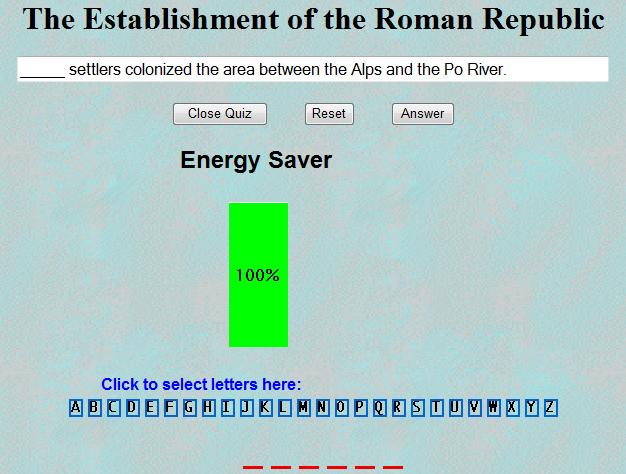
Our ENERGY SAVER quizzes operate just like old-fashioned Hangman. At the top, there is a question or a sentence with a blank space. Below is the energy box. Below this is the alphabet. At the bottom, there is one space for each letter of the answer or missing term. Students guess letters that they believe are part of the answer. When they guess incorrectly, the energy supply is depleted. These are great on a SmartBoard for playing as a class, or individually in the computer lab. If you have a classroom blog or webpage, you can link students directly to quizzes and games that they can do at home.

SILVERLIGHT MULTIPLE-CHOICE is a multiple-choice testing format which presents each question individually, rather than all questions on a single screen. Many of these questions incorporate visual elements, common on state regents and proficiency exams.

PLAYTIME is a two-player or two-team multiple-choice game that has a Vegas vibe to it. Each player pulls the lever to receive a question. The player with the biggest winnings is the winner.

MULTIPLE-CHOICE quizzes are created in a single-page format. These can be done as a group. They are excellent tools for individual students to use when studying for a test or exam.

FLASH CARDS have gone digital! Read the card, then answer it aloud or in your head. Flip it over to see if you were right. Track how many correct or incorrect answers you get. As you flip through the cards, remove those which you already know so that they aren't repeated.

None of these game styles are ultra-new or mind-blowing. But combining them with your SmartBoard or projector can make for a fun and productive classroom study session. They are all interactive, which means that no pencils, paper, chalk, boards, etc., are necessary.

Perhaps more importantly, our games are unit, chapter, and section specific. For example, under Roman civilization, we have five topics:

  • The Establishment of the Roman Republic
  • The Punic Wars
  • Civil War in Rome and the End of the Roman Republic
  • The Rise and Fall of the Roman Empire
  • The Barbarian Invasions and Migratory Period in Europe

Even better, all of our games are offered online for free. This means no CD-Roms to store, no membership fees, and no hassle. You don't even need a password or log-in to use the site and test your skill. Use these educational games and quizzes in the classroom or at home, for regular chapter tests, exam preparation, or even quiz bowl practice.

You can start by browsing our WORLD HISTORY games. If you don't see precisely what you're looking for, fret not. We are hard at work creating and uploading new games every day.


Sunday, May 16, 2010

Scholastic Printables


The Scholastic company has great printables that teachers can use for free.


Saturday, May 15, 2010

Using Electronic Resources and Searching on the Internet

Here is a great video on how students might conduct internet searches for research purposes.


Friday, May 14, 2010

India-to-the-U.S.: Finding Teaching Jobs in the United States

Many Indians (as well as Filipinos and others) are eager to find teaching positions in the United States. For the most part, applicants are well-spoken, qualified educators with years of experience. However, a great many are unfamiliar with the requirements for obtaining teaching credentials in the United States.

In many countries outside of the United States, a person with a degree in Mathematics can be hired to teach Mathematics in a high school. While this does occur to a limited degree in the United States, it is not the norm. Most teachers in the United States (particularly at public schools) must possess a degree in Education. Additionally, teachers must often pass state-conducted or other standardized tests (such as the Praxis). Foreign teachers can get teaching jobs in the United States, but they must first complete the requirements for teaching certification for the state (such as Michigan, New York, or California) in which they plan to teach.

Teaching certification requirements are different in each state because, according to the United States Constitution, the administration of education is left to individual states. A teacher certified to teach in Ohio cannot automatically teach in a public school in Texas. Click here for a list of teaching certification requirements (and teacher job postings) by individual states.

If you are unable or unwilling to complete the requirements for state certification, it is still possible for you to find a teaching job in the private sector. This could be in a religious (e.g., Catholic, Jewish, Muslim) school or in a private secular school.

Catholic schools are organized by diocese. There are hundreds upon hundreds of dioceses in the United States. Typically, a single office conducts teacher hiring for an entire diocese. The diocese will have a standardized application. You must apply for a teaching job directly with the diocese. For example, imagine that you want to teach Science in a high school in Toledo, Ohio. You would visit the website for the Diocese of Toledo and complete the application process. For another diocese or school, try doing a Google search (such as "diocese New York" or "Islamic school Detroit" or "Hebrew school New Jersey").

Note: Some religious schools require that teachers practice the faith of the school, but this is not always a requirement. For example, many non-Catholics teach in Catholic schools.

Even if you do not pursue a degree in Education from an American university, you should familiarize yourself with common American educational practices and beliefs. You will be asked questions about these practices during interviews. You should understand the U.S. attitudes toward inquiry- and student-based learning.

Good luck on your journey!

Saturday, May 8, 2010

Looking for a teaching job?

We are here to help not only new teachers, but current teachers making career and location changes.


Due to budget cuts and other factors, many teachers are finding themselves in a position where they must consider relocating to another district. If this describes you, take a look at our page of teacher certification requirements and educator job hiring links by state, including U.S. territories and military bases.


As this school year winds down, our thoughts are with all teachers who are faced with budget cuts, and left making tough decisions.

Thursday, January 1, 2009

Teaching Tip: Create a Classroom Blog

A classroom blog is a great way to reach out beyond the school walls to parents and students.

Instructions:
  1. Open a blogging account on a site like blogspot.com.
  2. Name your blog something simple that students will remember, like MSJOHNSONSENGLISHCLASS.
  3. Every day before you leave the building, post what happened that day. For example: "PERIOD SIX - ENGLISH I: Today we looked at the use of metaphor in writing, and read an excerpt from Sir Arthur Conan Doyle's Hound of the Baskervilles. The homework assignment is to answer questions 3, 5, and 7 on page 45 of the textbook. Tomorrow we will discuss these questions in class and begin discussing the development of mystery fiction."
  4. If you can't update every day, be sure to do so by the end of the week, making sure to list what was done in class and what assignments were given.

Benefits of a Classroom Blog:

  • Students and parents quickly and easily can see what assignments are due.
  • Make certain that parents know about the blog, because students may be tempted to keep it a bit of a secret. This way, when a student tells a parent, "I don't have any homework," the parent can quickly confirm it.
  • Teachers get a chance to highlight their organizational and teaching skills.
  • Supplemental learning can occur. If you're covering Shakespeare, you can post a link to a site dedicated to Shakespeare.
  • Parents are connected. Many parents who are dedicated to their children's education cannot contact teachers often, nor attend conferences. A classroom blog keeps parents informed and lets them know that the teacher cares about keeping parents informed.
  • Homework can be posted. Many schools offer hosting for notes, PowerPoints, etc. If not, there are free hosting sites available online. You can scan or copy/paste handouts, etc. You can copy/paste the instructions for a term paper. This will give students and parents easy access to "back-up" copies of assignments.
  • Students gain access to the educational benefits of technology.
  • Teachers are not pestered by students asking, "What did we do yesterday?" Such students can be directed to a classroom or library computer and told to check the blog.