Thursday, September 21, 2023

The Colonial Period in United States History

Learning about the colonial period in United States history is crucial for several reasons.

Foundation of American History: The colonial period is the foundational period of modern American history. It sets the stage for the development of the United States as a nation, providing essential context for understanding subsequent historical events.

Cultural and Social Diversity: The American colonies were incredibly diverse, with settlers from various European nations, Africans, and indigenous peoples. Studying this period allows students to explore the interactions, conflicts, and contributions of these diverse groups.

Origins of American Institutions: Many of the institutions and systems that are fundamental to the United States, such as representative government, religious freedom, and the legal system, have their origins in the colonial period.

Origins of American Values: The colonial period played a significant role in shaping American values, including concepts of individual liberty, democracy, and the pursuit of religious and economic freedom.

Colonial Economics: Understanding colonial economic systems, including agriculture, trade, and labor, helps students comprehend the economic foundations of the United States.

Conflict and Revolution: The colonial period saw conflicts such as the French and Indian War and the seeds of the American Revolution. Studying these events helps students grasp the causes and consequences of these critical moments in history.

Impact on Native Americans: Learning about the colonial period sheds light on the interactions between European settlers and indigenous peoples. It's essential to understand how Native American communities were affected by colonization.

Slavery and the Transatlantic Slave Trade: The colonial period was marked by the growth of slavery in the American colonies and the transatlantic slave trade. Exploring this history is vital for understanding the origins of slavery in America and its lasting impact.

Social Hierarchies: The colonial period saw the emergence of social hierarchies based on race, class, and gender. Examining these hierarchies helps students analyze the development of inequality in America.

Evolution of Colonies: The colonies themselves evolved over time, with differing systems of government, economies, and social structures. Studying these changes provides insights into how regions of the United States developed differently.

Lessons in Governance: Students can learn valuable lessons in governance by examining colonial systems of government, including self-governance in New England and proprietary colonies in the South.

Cultural Legacy: Many aspects of colonial culture, including architecture, language, and traditions, continue to influence American society today. Studying this period helps students appreciate the cultural heritage of the United States.

Lessons in Diversity and Tolerance: The colonial period presents opportunities to discuss the importance of religious tolerance and diversity in the United States and how these ideals evolved over time.

Historical Analysis Skills: Studying the colonial period equips students with critical thinking and historical analysis skills, which are valuable for understanding and interpreting other historical eras.

The colonial period is essential for understanding the roots of the United States, its institutions, values, and the complex interactions among diverse groups. It provides a foundational knowledge base for the study of American history and offers valuable lessons that are relevant to contemporary issues and challenges. Check out our free educational printables on the colonial period in American history.


Tuesday, January 2, 2018

Latest Releases - Free Printable Workbooks and More

Check out some of our latest releases:
European Renaissance Workbook - This 14-page, student-friendly workbook is part of our World History series. "The European Renaissance" focuses on the advances in art and literature that took place during the period running roughly from 1400 until 1700, as well as the socio-economic factors that fueled the Renaissance. Ages 12 and up.

"If I had a million dollars, I would..." Writing Prompt - Students complete this sentence on the lines provided. For upper elementary students.

Scream for Ice Cream Coloring Page - "I scream. You scream. We all scream for ice cream." Students are asked to read, trace, and write the sentences, then color the picture.

"The Executive Branch" Workbook - This 26-page workbook includes over 60 questions and activities, ranging from basic recall to critical thinking. The easy-to-follow format encourages independent student learning. It can operate as a stand-alone unit or as a supplement to the larger study of American history and government. Grades 7-12.

"Burghers of Calais" History Workbook - The Siege of Calais (1346) was a pivotal battle in the Hundred Years' War of the European Middle Ages. Learn about how England's Edward III and Queen Philippa dealt with the proposed martyrdom of the city's prominent citizens. This workbook is twelve pages in length and includes questions and activities. For grades seven through twelve.

Charlemagne Biography Workbook - Learn all about this famous and powerful king of France and Germany, who became the first emperor of the Holy Roman Empire. This Charlemagne biography workbook is 19 pages in length. For ages 12 and up.

Thursday, October 19, 2017

Latest Releases - Free Printables for Teachers

Free Educational Materials for K-12 Teachers and Students of All SubjectsCheck out some of our latest releases:
Pocahontas Bellwork Puzzle Worksheet - Students are asked to unscramble terms in order to complete six statements about the life of Pocahontas (circa 1596-1617). Then, students search for eight names in a word search puzzle. For grades four and up.

Powhatan Letter to John Smith DBQ Worksheet - Free printable DBQ worksheet on a letter written circa 1609; designed for high school United States History students.

Iran Political Map Worksheet - This stand-alone worksheet features a map of Iran followed by six multiple-choice questions. Our map worksheet on Iran is designed for students from upper elementary through high school.

Thirty Days Hath September Printable - Students are asked to read, trace, and write this famous mnemonic device rhyme. Available in print or cursive.

Japan: Meiji Restoration, Japanese Imperialism, and the Build-Up to World War II in Asia PowerPoint - Designed for high school World History. Includes review questions.

Nationalism Causes and Effects DIY Blank Chart Worksheet - For this DIY infographic worksheet, students are asked to list the short- and long-term causes and effects of the development of nationalism worldwide.

Abbreviations Handout - Here is a handy list of some common (and a few uncommon) abbreviations used in written English, as well as (where appropriate) the Latin translation.

Revolution and Nationalism in Mexico Printable Pop Quiz - This test features fifteen multiple-choice questions, to be printed on one double-sided sheet of paper.

Thursday, June 1, 2017

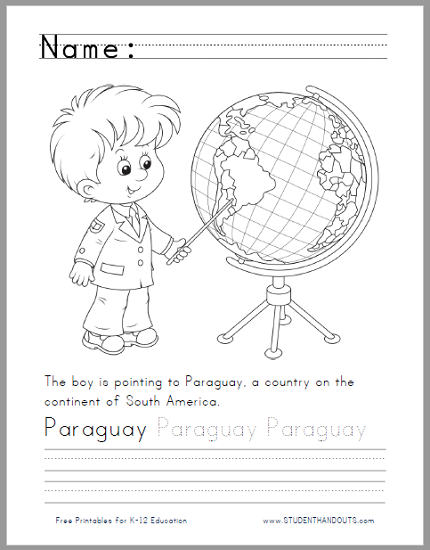
Paraguay on the Globe Coloring Sheet


"The boy is pointing to Paraguay, a country on the continent of South America." Students read the sentence, then read, trace, and write "Paraguay." Click here to print.

Monday, May 1, 2017

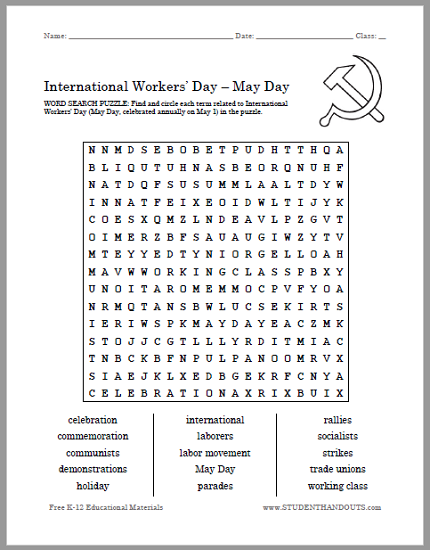
International Workers' Day Word Search Puzzle


WORD SEARCH PUZZLE: Find and circle each term related to International Workers’ Day (May Day, celebrated annually on May 1) in the puzzle.

Sunday, April 2, 2017

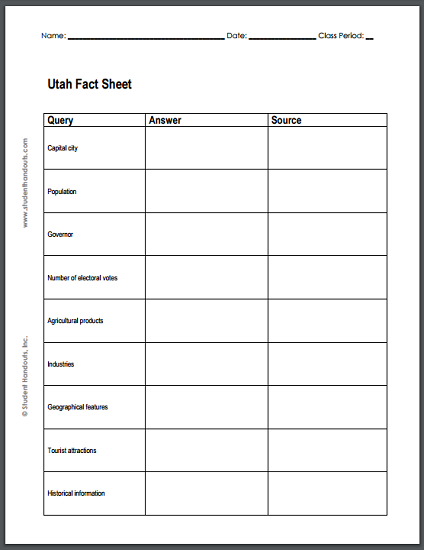
Utah Fact Sheet Notebooking Page


Here is a fun worksheet for having students research the state of Utah. Not only must students gather the information, but they must cite their sources. Topics include capital city, population, governor, number of electoral votes, agricultural products, industries, geographical features, tourist attractions, and historical information. Free to print (PDF file) here.

Sunday, March 26, 2017

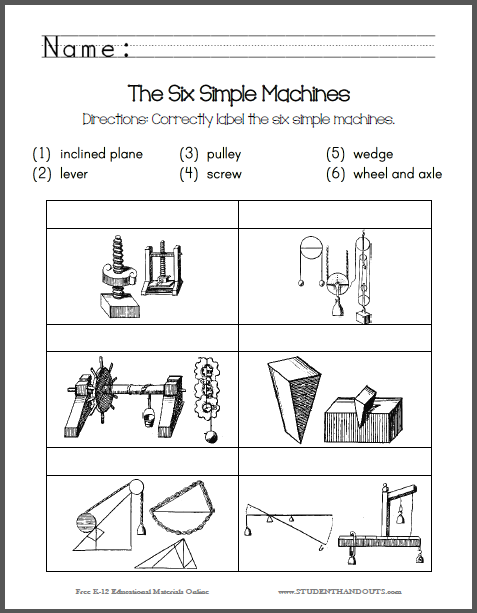
Identify the Six Simple Machines - Worksheet for Kids


Students are asked to identify the six simple machines: (1) inclined plane, (2) lever, (3) pulley, (4) screw, (5) wedge, and (6) wheel and axle. The images on this identification worksheet have a more basic engineering look than commonly used photographs. This simplicity helps students to understand the six simple machines in their most basic form, and to be able to better recognize them in everyday applications. Free to print (PDF file).