Friday, April 17, 2015

How to Pick a College Major

This is the time of year when high school seniors, and plenty of adults, select a college major. This post won't delve into the complicated issues of student loan debt, predatory college recruitment, or any of that. Instead, this post is basic advice on picking a major in college.


There are three major factors to consider: wants, needs, and abilities. This concept is best addressed by using a Venn diagram. And perhaps this article should have been subtitled "ignore everyone who tells you to follow your dreams, no matter what." This post is about giving realistic advice. Why? College is expensive. College completion rates are 50% or less. For those who manage to complete a four-year college degree, landing that dream job is even less likely. Think critically and plan carefully.

"Wants" refers to the things you want to do--work with animals, live in a warm climate, travel, etc. Place all of your wants in the "want to do" circle of your Venn diagram.

"Needs" refers to needs in the employment sector. In short, these are things that someone will pay you to do. If you're lost, look through employment ads. Become informed on what truly are growth industries (instead of relying on college recruiters). You may be surprised to learn that the job forecast for lawyers isn't currently very good, but there's plenty of room for more doctors (if you choose the right area of medicine).


"Abilities" refers to what you're actually capable of doing. This can be the harshest area to examine, but this is probably because it's the most crucial. Do you perform well on rigorous tests? If not, you may want to knock off any careers that require licensing. For example, nurses must pass an intensive state-mandated exam in order to become licensed.


Remember:

  • It's your career, and only a small part of you as a human being. Don't confuse your career with your identity as a person.
  • Interests and hobbies do not necessarily translate into careers, no matter what self-help gurus preach to you.
  • Always stay alert to career possibilities which may cause you to change your major or pick up a minor.
  • Pick up a minor or double major. It'll broaden your knowledge and skills base, and make you more appealing to a future employer.
Advice to any and all majors:
  • Learn a range of office skills--Quick Books, Excel, etc. Scan the wanted ads and you'll see these listed as desired skills for most entry-level positions. Your business degree may eventually lead you to the CEO position, but it will likely be your ability to create and manage spreadsheets that gets your foot in the door.
Example 1:
  • I want to work with animals.
  • I perform well on standardized tests, and could complete the coursework and licensure process for becoming a veterinarian.
  • Veterinary medicine is a growing field; there are additionally job opportunities at zoos.
  • I will major in veterinary medicine.
Example 2:
  • I want to work with children.
  • I perform poorly on standardized tests, and it will be very difficult for me to complete the coursework and licensure process to become a teacher.
  • Teachers are in demand, but largely in areas (special education, math, and science) which don't match my interests and abilities.
  • I will not major in education.
This can be an emotionally difficult process. No one wants to be told not to do something. But you're better off being told "no" now, than in four years, after you've spent a small fortune on your education.

How to cheat and do what you want anyway:
  • Remember that part about learning basic office skills? I repeat: Learn basic office skills.
  • Many employers are looking for someone with "a" college degree and a range of office skills. It doesn't necessarily matter if you majored in English, or math, or business; merely having a four-year degree and being proficient with various office computer programs can and will get you a job.
  • Office skills mark the dividing line between philosophy majors who work at coffee shops for minimum wage, and philosophy majors who earn three or more times as much money at white-collar jobs.

Thursday, March 19, 2015

Industrial Revolution Worksheets

Good news for junior and senior high school Social Studies teachers!

We've just recently reorganized all of our free printable worksheets on the Industrial Revolution. This meant cleaning up some old links, labeling certain worksheets by grade level, and creating thumbnails.

The thumbnails are (slowly but surely) being added all over the site by popular demand, because users keep telling us that it's much faster and easier to look at a small picture of a worksheet than to read a long description. One quick eye scan is all it takes to find an Industrial Revolution crossword puzzle, sheet of essay questions, and the like.

Each worksheet has its own page with an image. This is done for those of you who organize your lesson plan units on sites like Pinterest.

As always, all of our Industrial Revolution worksheets are completely free to print. Don't see something you're looking for on the page? Email us at webmaster [at] studenthandouts [dot] com with your request, and we'll see if we can help.

Industrial Revolution Worksheets


Just for fun, here's a picture of one of the more interesting figures from the Industrial Revolution--Isambard Kingdom Brunel. And what an awesome name he had!

Wednesday, February 25, 2015

Monkey Around Project

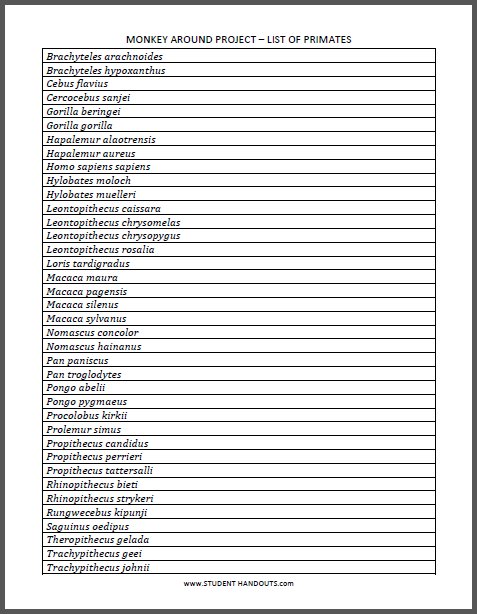
Monkey Around Project - The whole project is included. First, a list of 38 living primate species to assign to students. Then, a worksheet which each student completes on an assigned primate. There's even a cover sheet, to bind these together as a class booklet on primate species. Grades 1-6. Lots of fun! Click here.


Friday, February 6, 2015

Selma (2014) Movie Review and Note-taking Sheet

We've seen Selma and think it's great for high school students. Click here to access our free printable worksheet, to accompany the movie, which lists the names of ten historical figures featured in the film, so students can research and take notes.


Tuesday, October 28, 2014

Save and Reuse Your Tin/Aluminum Food Cans

For both environmental and economical reasons, we could all do with reducing, reusing, and recycling more often. Case in point: the numerous organizers and containers we buy that could easily be replaced with repurposed food tins.

We all buy food items in aluminum (or tin) cans--ravioli, soup, baked beans, you name it. Most of us are conscientious enough to put our used tin cans in the recycling bin.

But why not wash them out and reuse them?

First, you'll need a smooth-edge can opener like the OXO Good Grips Smooth Edge Can Opener. This leaves a smooth edge on both the can and the lid.

FYI: Leave the label on, and you've got a "dummy can" that can fool burglers. Stash emergency cash or expensive jewelry in it, place the lid back on, and put it back in your pantry. With the label intact, a thief will never guess what's really hidden inside!

For everyday stuff, peel off the label before washing the can. (Place the lid in the recycling bin.) Voila! There you are--a can that can be used for storing any number of things around the house, garage, or classroom.

Use it for:
  1. Pen and pencil bin.
  2. Paint brushes (or paint).
  3. Loose "junk" in a drawer.
Crafty? Wrap the tin can in black gaffer tape or designer duct tape. You can even use fancy chalkboard sticker labels to label each can's contents.

There's no need to stop with tin cans. To the left is a creamer bottle I washed. It used to contain powdered cream for my coffee. The creamer label was a wrapped plastic sheet that tore away easily. I filled it with extra pencils. I can unscrew the top if I want, or pop the top and "pour" out one pencil at a time. I can mark each bottle "colored pencils" or "markers" or "sharpies" using a sharpie, or using the fancy chalkboard labels already mentioned.

The plastic tubs keep markers from drying out! I use enough creamer in my coffee (and I drink A LOT of coffee) to collect many of these. They are very convenient for organizing student materials.

In junior and senior high school Social Studies/History classes, we write and draw on a lot of maps. The trick? Keep about a dozen of these, filled with a handful of colored pencils, markers, etc., as well as an inexpensive 6" ruler. (With high school kids, I've cut freebie bendable plastic rulers in half!) When map time comes around, each pair of students (or each student, if there are enough containers) gets a plastic bottle of drawing supplies. It's so easy and convenient! And with screw-on lids, the contents don't fall out.

The moral of this story? Think before you toss items into the recycling bin. Take the container, remove its labels, and wash it out. Give it a long, hard look. What can you use it for? You'd be surprised how many ideas come to mind.

Tricks:

  • Use an orange peel to remove gummy labels (soaking in warm water also works).
  • Use nail polish remover to remove stamped-on expiration dates.
  • Use duct tape to cover up labels that can't be removed.

Sunday, October 19, 2014

Reign Television Series on CW

October 19, 2014 (New York, NY) - Reign is a television program aired on the CW network. It is very loosely based on the life of Mary Queen of Scots, focusing on her marriage to Francis of France. Currently in its second season, this television series is best described as historical fiction. The real Mary Queen of Scots (lived 1542-1587) was married, as a young girl, to the Dauphin of France, the future Francis II (lived 1544-1560), son of Henry II (lived 1519-1559) and Catherine de' Medici (1519-1589). Continue reading

Friday, October 3, 2014

Capitalizing Titles

Sometimes we find something online, and can only ask, "Why didn't I think of that?"

Here is an instant title capitalization service. Enter your title in the box, and presto, it's correctly capitalized for you. Ingenious!