Monday, June 16, 2025

Physical Worksheets Can Combat Screen Addiction and the Specter of AI Plagiarism

Let's Hop Off the Information Superhighway!

In today’s digital age, children are increasingly glued to screens, risking addiction and passive consumption of information. Similarly, the rise of AI tools tempts students to copy answers rather than think critically. Physical, printed worksheets offer a simple yet powerful solution to both problems.  

Printables Really Do Reduce Screen Dependency

We realize this may seem ironic, coming from educators who publish content on the world wide web! All the same, printed worksheets provide a tangible break from devices, reducing eye strain and improving focus. The act of writing by hand engages motor skills and enhances memory retention more effectively than typing. Unlike digital distractions, worksheets encourage uninterrupted, deep work—a skill eroded by our incessant notifications and multitasking. Parents can set screen-free study sessions, fostering healthier habits and mindful learning.  

Printables Prevent AI-Generated Plagiarism

With AI chatbots capable of instantly completing assignments, students may bypass genuine learning. Worksheets—especially those requiring handwritten responses, drawings, or problem-solving—make plagiarism harder. Teachers and parents can personalize tasks (e.g., "Write about your summer trip") to ensure originality. Physical work also creates a paper trail, making progress easier to track than digital submissions prone to copy-pasting.  

Bonus Benefits 

Worksheets encourage creativity, allowing doodling or margin notes that digital formats restrict. They’re also accessible offline, ideal for travel or low-tech environments. By integrating worksheets into your routines, you can help the children under your supervision to develop discipline, critical thinking, and a healthier relationship with technology—one page at a time.

Thursday, June 12, 2025

Melding Learning and Living: Helping Kids Retain Knowledge During Summer Break

Savvy parents can prevent the horror of summer learning loss by making education engaging and fun. But how, you ask?

Encourage daily reading by visiting local libraries or creating a family book club. Do you have a favorite story? Reread it with your kid as they read it for the first time. And believe it or not, even teens love bedtime stories! Consider reading aloud to your teenager at bedtime. 

Incorporate math into everyday activities like cooking (measuring ingredients) or shopping (calculating discounts). The trick is to make it cool and interesting. Is that sale price really a bargain? Find out together!

Educational games, puzzles, and apps can reinforce skills while keeping kids entertained. FYI you can learn about and explore our free online and printable educational games here.

Plan museum trips, science experiments, or nature walks to spark curiosity. Set aside short, consistent study times for review workbooks or online learning programs. Discuss current events or documentaries to build critical thinking. Most importantly, balance structure with free play—kids learn through exploration. By blending learning into summer routines, parents help children retain knowledge while fostering a lifelong love for discovery.

Another Little Tip: Let your kids choose topics they enjoy—when learning aligns with their individual interests, retention improves naturally!


Helping Kids Retain Knowledge During Summer Break

Monday, January 15, 2024

First One Hundred Days of School

Celebrating the first one hundred days of school in the classroom can be a fun and educational activity for teachers, students, parents, and school staff. Here are some creative and engaging ideas for celebrating this annual milestone. Party with us!

Celebrate the first one hundred days of school with www.studenthandouts.com


Monday, November 6, 2023

What is the standard Social Studies curriculum?

The standard Social Studies curriculum can vary by grade level, school district, and state, but it typically covers a range of topics and concepts designed to provide students with a comprehensive understanding of the social sciences, history, geography, and civic education. Below is an overview of the general topics often included in the Social Studies curriculum: Our free Social Studies curriculum worksheets and workbooks tick all of these boxes.

What is the Social Studies curriculum?

Civic Education:

  • The structure and functions of government (local, state, and federal levels)
  • The rights and responsibilities of citizens
  • The principles of democracy and the U.S. Constitution
  • Civic engagement and participation in the democratic process
  • The rule of law and the justice system
History:
  • U.S. history, including major events, eras, and influential figures
  • World history, with an emphasis on significant civilizations, empires, and historical events
  • The study of historical documents, primary sources, and historical research methods
Geography:
  • Physical geography, including landforms, climate, and ecosystems
  • Human geography, including population, culture, and urbanization
  • Geographic regions and their characteristics
  • Map skills and spatial awareness
Economics:
  • Basic economic principles, such as supply and demand
  • Personal finance and financial literacy
  • Economic systems (e.g., capitalism, socialism)
  • The role of government in the economy
  • Global economic issues and trade
Social and Cultural Studies:
  • Cultural diversity and multiculturalism
  • The study of different cultures, traditions, and customs
  • Social issues and societal change
  • Gender studies, civil rights, and social justice
Global Studies:
  • The study of global issues, including human rights, environmental concerns, and international conflicts
  • International organizations (e.g., United Nations)
  • Globalization and its impacts
Current Events and Contemporary Issues:
  • Analysis of current events and their relevance to society
  • Discussion of contemporary issues, such as climate change, immigration, and technology's impact on society
Critical Thinking and Research Skills:
  • Analytical thinking and problem-solving
  • Research skills, including the evaluation of sources
  • The development of critical perspectives and informed opinions
Interdisciplinary Connections:
  • Integration of social studies with other subjects, such as language arts, science, and mathematics, to explore cross-disciplinary themes
Skills and Values:
  • Skills related to responsible citizenship, such as empathy, communication, and cooperation
  • The promotion of democratic values, ethics, and responsible decision-making

It is important to note that the specific content and sequence of the Social Studies curriculum can vary based on grade level and educational standards set by individual states or school districts. Additionally, educators often have the flexibility to adapt and enrich the curriculum to suit the needs and interests of their students.

Our free Social Studies curriculum aims to provide students with a well-rounded education that prepares them to be informed, engaged, and responsible members of society. It encourages critical thinking, civic participation, and an appreciation of diverse cultures and historical perspectives.

Monday, October 23, 2023

Staying Quiet During Tests

Maintaining a quiet testing environment in schools is crucial for several reasons, as it directly impacts the fairness, accuracy, and integrity of the assessment process. 

Fair Assessment: A quiet testing environment ensures that all students have an equal opportunity to demonstrate their knowledge and skills. Excessive noise or disruptions can disadvantage some students, potentially leading to unfair test results. 

Concentration and Focus: A quiet setting allows students to concentrate and focus on the test questions and tasks without distractions. This is essential for their best performance, as distractions can lead to errors and incomplete responses. Continue reading...

Monday, October 9, 2023

Free U.S. Citizenship Test

Candidates for American citizenship must correctly answer six out of ten questions in an oral examination conducted by a USCIS (United States Citizenship and Immigration Services) officer. These questions are taken from this pool of one hundred questions.


Kids have a lot of fun testing themselves to see if they'd qualify!


Thursday, September 21, 2023

The Colonial Period in United States History

Learning about the colonial period in United States history is crucial for several reasons.

Foundation of American History: The colonial period is the foundational period of modern American history. It sets the stage for the development of the United States as a nation, providing essential context for understanding subsequent historical events.

Cultural and Social Diversity: The American colonies were incredibly diverse, with settlers from various European nations, Africans, and indigenous peoples. Studying this period allows students to explore the interactions, conflicts, and contributions of these diverse groups.

Origins of American Institutions: Many of the institutions and systems that are fundamental to the United States, such as representative government, religious freedom, and the legal system, have their origins in the colonial period.

Origins of American Values: The colonial period played a significant role in shaping American values, including concepts of individual liberty, democracy, and the pursuit of religious and economic freedom.

Colonial Economics: Understanding colonial economic systems, including agriculture, trade, and labor, helps students comprehend the economic foundations of the United States.

Conflict and Revolution: The colonial period saw conflicts such as the French and Indian War and the seeds of the American Revolution. Studying these events helps students grasp the causes and consequences of these critical moments in history.

Impact on Native Americans: Learning about the colonial period sheds light on the interactions between European settlers and indigenous peoples. It's essential to understand how Native American communities were affected by colonization.

Slavery and the Transatlantic Slave Trade: The colonial period was marked by the growth of slavery in the American colonies and the transatlantic slave trade. Exploring this history is vital for understanding the origins of slavery in America and its lasting impact.

Social Hierarchies: The colonial period saw the emergence of social hierarchies based on race, class, and gender. Examining these hierarchies helps students analyze the development of inequality in America.

Evolution of Colonies: The colonies themselves evolved over time, with differing systems of government, economies, and social structures. Studying these changes provides insights into how regions of the United States developed differently.

Lessons in Governance: Students can learn valuable lessons in governance by examining colonial systems of government, including self-governance in New England and proprietary colonies in the South.

Cultural Legacy: Many aspects of colonial culture, including architecture, language, and traditions, continue to influence American society today. Studying this period helps students appreciate the cultural heritage of the United States.

Lessons in Diversity and Tolerance: The colonial period presents opportunities to discuss the importance of religious tolerance and diversity in the United States and how these ideals evolved over time.

Historical Analysis Skills: Studying the colonial period equips students with critical thinking and historical analysis skills, which are valuable for understanding and interpreting other historical eras.

The colonial period is essential for understanding the roots of the United States, its institutions, values, and the complex interactions among diverse groups. It provides a foundational knowledge base for the study of American history and offers valuable lessons that are relevant to contemporary issues and challenges. Check out our free educational printables on the colonial period in American history.

Tuesday, January 2, 2018

Latest Releases - Free Printable Workbooks and More

Check out some of our latest releases:
European Renaissance Workbook - This 14-page, student-friendly workbook is part of our World History series. "The European Renaissance" focuses on the advances in art and literature that took place during the period running roughly from 1400 until 1700, as well as the socio-economic factors that fueled the Renaissance. Ages 12 and up.

"If I had a million dollars, I would..." Writing Prompt - Students complete this sentence on the lines provided. For upper elementary students.

Scream for Ice Cream Coloring Page - "I scream. You scream. We all scream for ice cream." Students are asked to read, trace, and write the sentences, then color the picture.

"The Executive Branch" Workbook - This 26-page workbook includes over 60 questions and activities, ranging from basic recall to critical thinking. The easy-to-follow format encourages independent student learning. It can operate as a stand-alone unit or as a supplement to the larger study of American history and government. Grades 7-12.

"Burghers of Calais" History Workbook - The Siege of Calais (1346) was a pivotal battle in the Hundred Years' War of the European Middle Ages. Learn about how England's Edward III and Queen Philippa dealt with the proposed martyrdom of the city's prominent citizens. This workbook is twelve pages in length and includes questions and activities. For grades seven through twelve.

Charlemagne Biography Workbook - Learn all about this famous and powerful king of France and Germany, who became the first emperor of the Holy Roman Empire. This Charlemagne biography workbook is 19 pages in length. For ages 12 and up.

Thursday, October 19, 2017

Latest Releases - Free Printables for Teachers

Free Educational Materials for K-12 Teachers and Students of All SubjectsCheck out some of our latest releases:
Pocahontas Bellwork Puzzle Worksheet - Students are asked to unscramble terms in order to complete six statements about the life of Pocahontas (circa 1596-1617). Then, students search for eight names in a word search puzzle. For grades four and up.

Powhatan Letter to John Smith DBQ Worksheet - Free printable DBQ worksheet on a letter written circa 1609; designed for high school United States History students.

Iran Political Map Worksheet - This stand-alone worksheet features a map of Iran followed by six multiple-choice questions. Our map worksheet on Iran is designed for students from upper elementary through high school.

Thirty Days Hath September Printable - Students are asked to read, trace, and write this famous mnemonic device rhyme. Available in print or cursive.

Japan: Meiji Restoration, Japanese Imperialism, and the Build-Up to World War II in Asia PowerPoint - Designed for high school World History. Includes review questions.

Nationalism Causes and Effects DIY Blank Chart Worksheet - For this DIY infographic worksheet, students are asked to list the short- and long-term causes and effects of the development of nationalism worldwide.

Abbreviations Handout - Here is a handy list of some common (and a few uncommon) abbreviations used in written English, as well as (where appropriate) the Latin translation.

Revolution and Nationalism in Mexico Printable Pop Quiz - This test features fifteen multiple-choice questions, to be printed on one double-sided sheet of paper.

Thursday, June 1, 2017

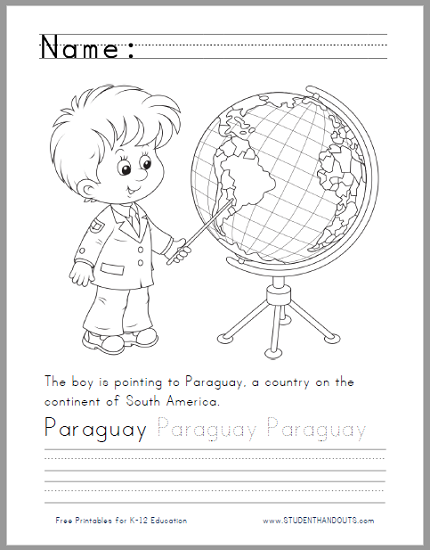
Paraguay on the Globe Coloring Sheet


"The boy is pointing to Paraguay, a country on the continent of South America." Students read the sentence, then read, trace, and write "Paraguay." Click here to print.

Monday, May 1, 2017

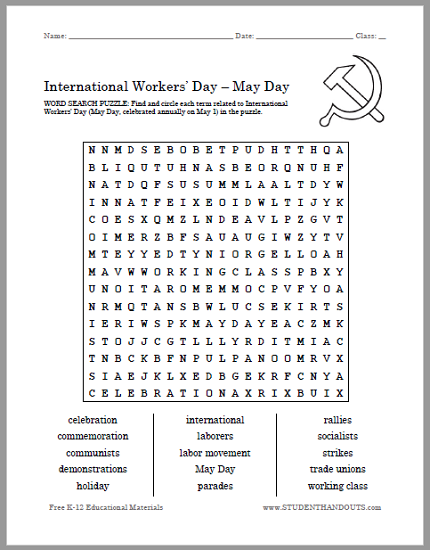
International Workers' Day Word Search Puzzle


WORD SEARCH PUZZLE: Find and circle each term related to International Workers’ Day (May Day, celebrated annually on May 1) in the puzzle.

Sunday, April 2, 2017

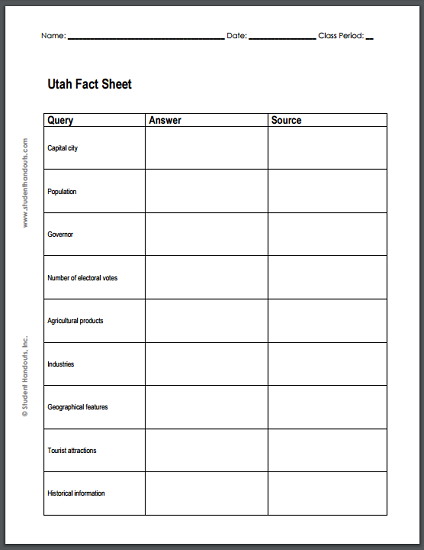
Utah Fact Sheet Notebooking Page


Here is a fun worksheet for having students research the state of Utah. Not only must students gather the information, but they must cite their sources. Topics include capital city, population, governor, number of electoral votes, agricultural products, industries, geographical features, tourist attractions, and historical information. Free to print (PDF file) here.

Sunday, March 26, 2017

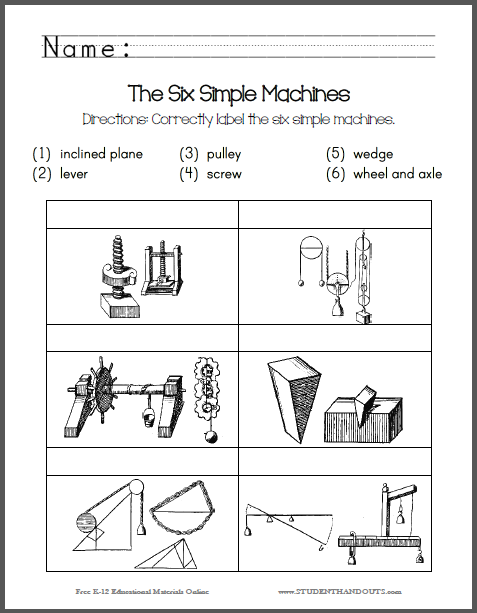
Identify the Six Simple Machines - Worksheet for Kids


Students are asked to identify the six simple machines: (1) inclined plane, (2) lever, (3) pulley, (4) screw, (5) wedge, and (6) wheel and axle. The images on this identification worksheet have a more basic engineering look than commonly used photographs. This simplicity helps students to understand the six simple machines in their most basic form, and to be able to better recognize them in everyday applications. Free to print (PDF file).

Thursday, March 23, 2017

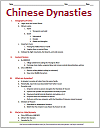
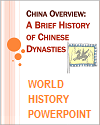
Ancient China Outlines and PowerPoints

Here are some free outlines and PowerPoints (with guided student notes) on ancient Chinese history, designed for high school World History students. Enjoy!


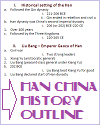
Han Dynasty of China History PowerPoint

Han Dynasty of China History Outline

Chinese Dynasties Brief History Outline

Chinese Dynasties History PowerPoint

Tuesday, December 27, 2016

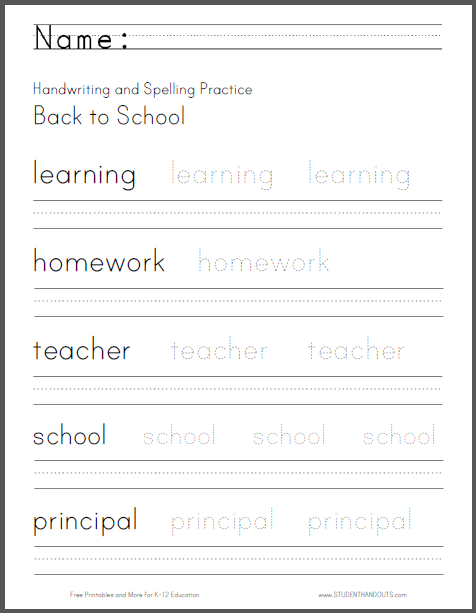
Getting First Graders Ready for School

Here are some fun worksheets to help first graders get back into the school groove. They are free to print.


Wednesday, December 14, 2016

America's Story for America's Children by Mara Louise Pratt-Chadwick

A century ago, Mara L. Pratt-Chadwick wrote numerous popular books for children. The focus of her writing was typically the history of the United States. In America's Story for America's Children, she sought to introduce second grade students to American history.

We have adapted Pratt-Chadwick's lovely little book into a series of workbooks. These offer an introductory history of the U.S.A., from the landings of the Vikings in 1000 C.E., through the Civil War (1861-1865). Native American histories are included in the stories of Montezuma II and of Leaping Wolf. Language, grammar, etc., have been updated for modern readers.


  • The Northmen: Vikings in North America, 1000
  • Olaf and Snorri: Vikings and Native Americans
  • Christopher Columbus, 1492
  • Montezuma II of the Aztec (1466-1520)
  • Little Pueblo Prince and Coronado (circa 1540)
  • Virginia Dare and Roanoke (circa 1587)
  • Leaping Wolf: Iroquois and French (circa 1600)
  • Betty Alden and the Puritans (1623-1717)
  • Hans and Katrina in New Amsterdam (circa 1630s)
  • Marquette and Joliet Explore America in 1672
  • Eliza Lucas Cultivates Indigo in South Carolina (1700s)
  • George III and the American Revolution
  • The Stamp Act of 1765
  • The Boston Boys: American Revolution
  • The Army of Two: War of 1812
  • The Boy in Grey: U.S. Civil War
  • The Boy in Blue: U.S. Civil War


  • These workbooks are wonderful for classroom use, as they contain informational texts, valuable recall questions, handwriting and spelling practice, and much more. They are also valuable as a cherished supplement for those children whose minds desire to stay active.

    Sunday, May 15, 2016

    Learning the ABCs in Time for Kindergarten

    This is the time of year when parents start registering their children for kindergarten in the fall. A growing number of schools, particularly in the United States, now require that kids enter the kindergarten classroom knowing their ABCs (reading and writing them) and knowing how to print their names.

    With these facts in mind, we have a large number of free handwriting practice worksheets. We even have individualized printables to help students learn to write their first names.


    Monday, May 9, 2016

    Fairy Tale Units

    Fairy tales! Children love them. They are classic and fun and part of the curriculum. But where to find materials for teaching and exploring fairy tales? We have many free fairy tale lesson plans. We put these together to help both teachers who are compiling a unit on fairy tales, and teachers who may need emergency lesson plans for a substitute.

    There are classics like Puss in Boots and Cinderella, along with more obscure classics like Riquet with the Tuft and Hans in Luck.

    The texts are all in free printable PDF format, and there are worksheets to supplement the lessons.

    Saturday, April 30, 2016

    Summer is nearly here!

    In case you haven't noticed, we've been undergoing a major overhaul of the site which will (fingers crossed) hopefully be complete by the start of the 2016-2017 academic year. All of the free printable worksheets, PowerPoints, outlines, games, and activities are still up. We are simply giving the site a facelift, and improving how the educational materials are organized.

    For those of you hoping to keep students busy and learning this summer, check out our free worksheets and activities for summer. Of course, most of the site is applicable to each season. But these are a few items which are exclusive to summer. Enjoy!

    Tuesday, January 12, 2016

    World History Movie Guides for Teachers

    We are completely reorganizing our World History units, which means reorganizing the book and film reviews on each unit topic. We think they look a lot nicer, and are much easier to navigate. You can take a look at the new pages of film guides and reviews for World History-Global Studies here.